
Crisis Communications and Legal Ethics
LEADERSHIP MATTERS
guiding principles
In a crisis situation, your first response is what is remembered the most and it’s critically important to get it right. When handled well, these high profile situations can be an opportunity to demonstrate values, build trust and confidence. Be prepared to:
- Put people first.
- Respond quickly and accurately.
- Show empathy and compassion.
- Be as transparent as possible.
- Become the trusted source of information – let all audiences hear from us first.
- When appropriate, follow the authorities’ lead.
HOW BEST DO I REACH KEY AUDIENCES
IN A TIME OF CRISIS?
Gone are the days of reaching everyone via news conference. Be prepared with:
- Media protocol
- Media statements
- Interview-ready executives
- A social media response library
- Third party experts
- Email and letter templates
Based upon your crisis assessment and your key audiences, Mueller will help you prepare draft messages and template communications to ensure you’ve got a head start in any crisis situation.
Proactive
vs.
reactive
- news conference
- news release
- media advisory
- media pitch
- in-person interviews
reactive
- standby statement
- written responses
- team approach and coaching
- administrative response team
assess and prepare
what does a crisis mean to you?
Crisis severity is tied to the “lead-time” you will have in preparing your response and the likelihood that the issue will generate media, social media or legal attention.
level 1:
most severe
Critical, onsite emergency response from authorities, high-risk of social media “breaking the news” with compelling visuals, maximum media interest, with media likely to show up on site.
Examples: Death, operation shutdown, natural disaster
level 2:
severe
Likely onsite emergency response from authorities, likely social media posts with compelling visuals, potentially high media interest, media may may show up on site.
Examples: Injury, data breach, criminal activity, class-action litigation
level 3:
moderate
Onsite emergency response unlikely, less likely social media posts (lack of compelling visual), some media interest, unlikely media will show up onsite.
Examples: Regulatory violation, employee / contractor disagreement, recall, executive death, social unrest
level 4:
minor
No emergency response, unlikely social media interest, potential media interest, likely longer lead time and unlikely media will show up on site.
Examples: Negative reviews on social media, minor lawsuit, property damage / vandalism, layoffs
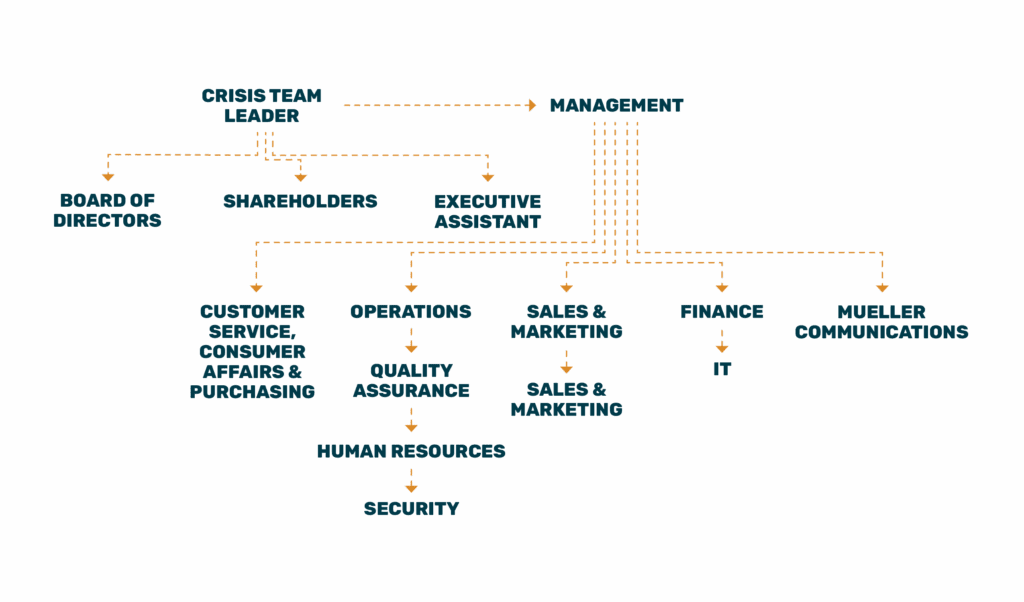
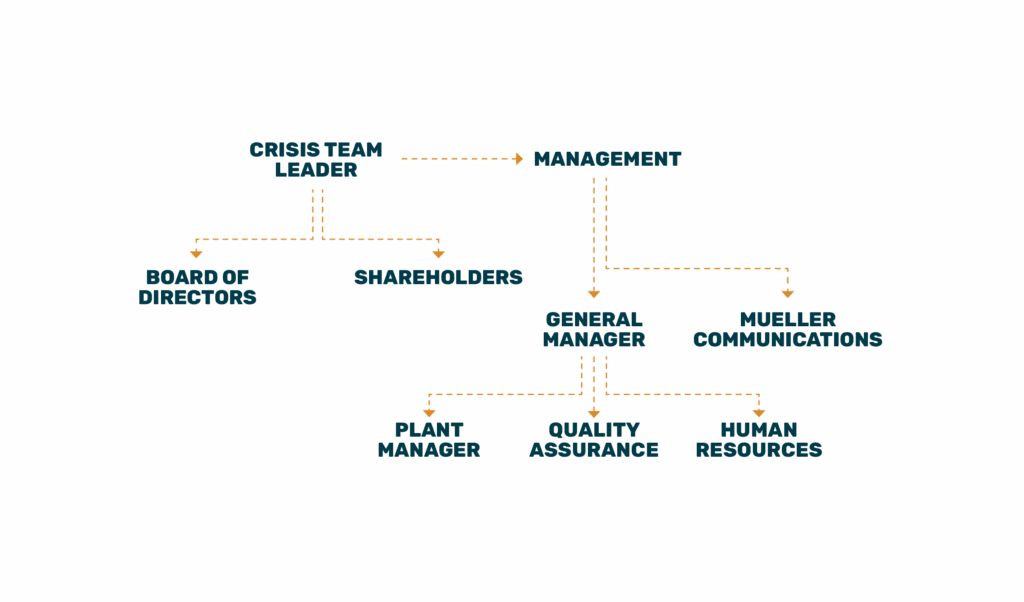
who should be on your
CRISIS MANAGEMENT TEAM?
The following functions should be represented:
Phone tree examples
download a free crisis plan template
communications & crisis response
communication do’s
- Show concern
- Speak with one voice
- Take charge quickly
- Be open and responsive
- Stick to the facts
- Keep your cool
- Share important information in simple, declarative sentences
- Correct your mistakes
- Address the perception
- Clearly state actions being taken
communications & crisis response
communication don’ts
- Say “no comment”
- Speculate, predict or answer hypothetical questions
- Give long, rambling answers
- Lose your temper
- Get into a debate
- Say anything “off the record”
- Evade, cover up or block access to other sources of information
- Try to answer a question if you don’t know the answer
- Assume anything
CRISIS COMMUNICATIONS
IN ACTION
Keeping a community calm and safe
Learn how Mueller Communications helped a Wisconsin municipality after it discovered that a neighborhood built adjacent to and on top of a former landfill may have explosive levels of methane gas building up. High levels of methane gas could cause a home to explode, resulting in injury or death, and required a quick and coordinated approach to communications.
a challenging announcement for a growing business
Faced with a challenging decision to close two of its facilities, a local manufacturer – one of the largest, full-service, visual identification companies in the United States – turned to Mueller Communications to facilitate an inside-out announcement approach.