
By: Andy LeDuc
Can you get us into AI results?” We’re being asked this question weekly. It’s not just curiosity – it’s recognition that AI is quietly reshaping how people find, trust, and act on information. There hasn’t been a technology shift like this in decades – and it’s moving fast. Generative AI tools – like ChatGPT, Gemini and Claude – have been so immediately helpful that they’re changing human decision-making, and as a result, changing the levers of influence communicators need to pull.
What is AIO?
AI Optimization (AIO) helps businesses shape the narrative that AI models retrieve and generate when people ask questions relevant to their brand, products, category, or competitors. Just as SEO helps a website rank in Google search, AIO helps AI-generated answers represent a brand accurately and favorably. The industry is still sorting out what exactly to call it, with some preferring Generative Engine Optimization (GEO) or Answer Engine Optimization (AEO), but for the sake of simplicity, our firm is using the umbrella term of AI Optimization (AIO). It is, fundamentally, an effort to signal relevance to AI-based tools.
Why it matters: There’s a new intermediary in town
As communicators, we’ve always worked through intermediaries, hence the term “media.” Now, in addition to journalists, search engines, and social networks, we must master the newest intermediary, AI. Increasingly, people are turning first to AI tools – like ChatGPT – to do their research, rather than a search engine. And when you turn to search engines – whether Google or Bing – the user is presented with an AI summary response first. What was once a direct click to the website that ranked highest for the words you searched is now an AI-generated summary from multiple sources, often bypassing the contributing websites. 
The rise of “zero-click” search
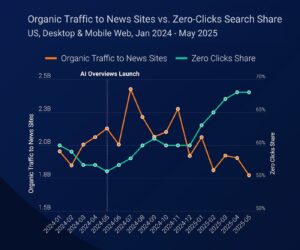
When Google shows AI summaries (“AI Overviews”), fewer people click through to the underlying websites. A recent Ahrefs study showed that when Google provided an AI summary, it resulted in a 34.5% drop in click-through rates (CTR) for top organic listings. A study from SimilarWeb tells a similar story: organic traffic to news sites has dropped by 26% since Google launched AI Overviews. The positioning of AI summaries as an intermediary between viewers and sources is a shocking realignment of how to capture a searcher’s attention in the digital ecosystem.
What does AI chat usage mean for my brand?
In classic SEO, brands compete to rank. In AIO, the goal is to be cited, summarized, and positively framed by the AI models people now trust for quick answers. If content isn’t structured for AI consumption, a brand may be misrepresented, ignored, or overshadowed by competitors with stronger AI presence. Monitoring and responding to how a brand and/or its industry is represented in the discussions, questions, and scenarios is essential.
Brand control in the age of “AI voice”
Preparing your brand for these changes takes intentionality. At Mueller Communications, we have built a tool to gather and monitor questions, responses, accuracy, and sentiment so that we know how and where to direct AI optimization and content strategy.
Whether you’re working with a partner or doing it on your own, here are some things to consider as you work to optimize your brand for AI: